For sick or injured wild animals in Washtenaw County, call our 24/7 ambulance (734) 661-3512.
Leave a message, and we will return your call ASAP.
For healthy, stray animals, please contact your local animal control or police department.
For sick or injured wild animals in Washtenaw County, call our 24/7 ambulance (734) 661-3512.
Leave a message, and we will return your call ASAP.
For healthy, stray animals, please contact your local animal control or police department.
NEVER remove an animal from their natural habitat, nest, or burrow without consulting professionals first!
The animal DOES NOT need help if:
The animal DOES need help if:

Use caution
If you encounter a wild animal exhibiting any of these signs, it’s important to contact your local humane society, wildlife rehabilitation center, or veterinarian for advice on the best course of action. Avoid handling the animal yourself unless absolutely necessary, as it can be dangerous for both you and the animal, particularly when an animal is distressed. Always prioritize professional assistance to ensure the animal receives the appropriate care.
Washtenaw County
Please contact HSHV first at (734) 661-3512 if the animal is in Washtenaw County. If an adult deer has been hit by a car, please also contact the Washtenaw County Sheriff’s Office non-emergency dispatch at (734) 994-2911.
Babies ALWAYS have a better chance of survival if they can be reunited with their mother. Despite the great work wildlife rehabilitates do, it does not replicate the care a mother animal can provide. Please DO NOT give an animal any food or water unless specifically instructed by a professional. If you must handle a wild animal, please use protective gloves.

→ YES, does the baby squirrel have a fluffy tail and a body longer than 6 inches?
→ NO, if the baby is not warm to the touch, warm it with your hands, and then place the baby in a container lined with tissues or soft cloth and place it in the tree where it was found for the mother to come back for. If it is still there after a couple hours, please contact your local humane society or veterinarian.
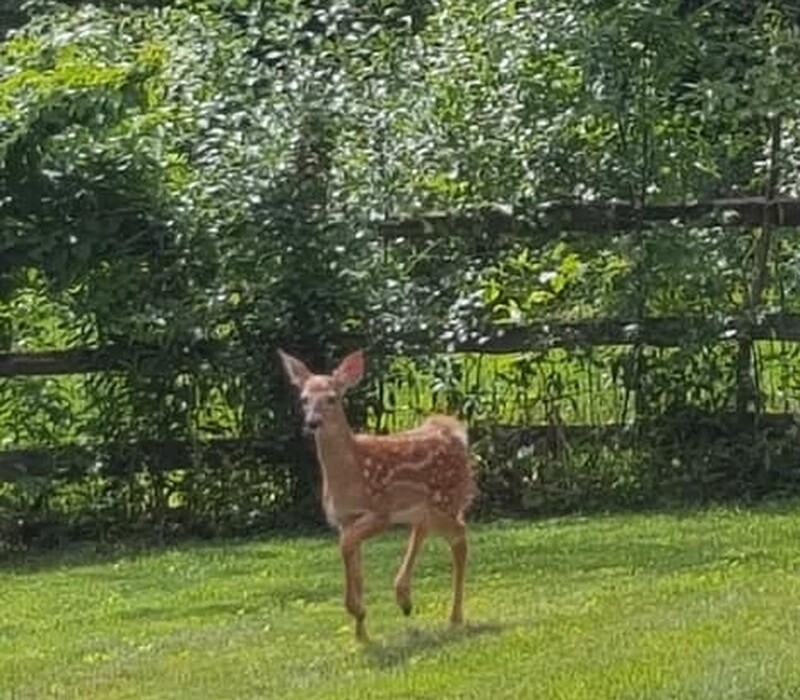
→ YES, please leave the fawn alone. The mother is nearby and will come back.
→ NO, if the fawn is lying on their side, crying out, running around, or has a visible injury, please contact your local humane society or veterinarian.
Signs of illness may include discharge from eyes or nose, lethargy, appearing emaciated (highly visible rib cage), being covered in fleas or other parasites or eggs/larvae.
→ YES, place the baby raccoon in a container lined with cloth or soft tissue and leave it near where it was found around dusk for the mother to come back for. If it is still there after a couple hours, please contact your local humane society or veterinarian.
→ NO, please contact your local humane society or veterinarian.
Signs of illness may include discharge from eyes or nose, lethargy, appearing emaciated (highly visible rib cage), being covered in fleas or other parasites or eggs/larvae.
→ YES, please leave it alone. Young skunks are very adventurous and will explore on their own. If you still see it alone with no mother after several hours, please contact your local humane society or veterinarian.
→ NO, please contact your local humane society or veterinarian.
→ YES, if the animal appears healthy and alert and there are more members of the same species nearby, try to unite it with the others. Make sure you give the animals space after moving them closer together. If it is visibly injured or is lethargic, please contact your local humane society or veterinarian.
→ NO, the animal is a juvenile and is able to take care of itself. As long as the animal appears healthy and alert, the animal will be perfectly fine on its own. If it is visibly injured or is lethargic, please contact your local humane society or veterinarian.
→ YES, this bird is a fledgling. It is normal for fledglings to be out of the nest while learning to fly. The parents are still actively taking care of it so it can be left alone. If it is visibly injured or is lethargic, please contact your local humane society or veterinarian.
→ PARTIALLY, this bird is a nestling. If the nestling is not alert and opening its mouth for food, please contact your local humane society or veterinarian.
→ NO, this bird is a hatchling. If the animal is not warm to the touch, please contact your local humane society or veterinarian.
→ YES, the mother has likely lost that baby. Opossums will carry up to 13 babies at once, with many not surviving to adulthood. Mothers will not return for lost babies. Please contact your local humane society or veterinarian.
→ NO, if the animal does not have a visible injury, please leave the animal alone.
Our partnership with wildlife rehabilitators has saved thousands of lives. If you have a general question or would like information on wildlife, these agencies are excellent resources:
Need an unwanted intruder evicted from your home or garage and want it done with compassion and skill, without causing the animal injury or unnecessary harm? HSHV offers Humane Wildlife Removal Services for Washtenaw County residents. Let us help you resolve your wildlife conflict with compassion and know-how. Our rates are extremely affordable and our care is truly humane. Plus, every cent goes back to help homeless, injured and abused animals!
Sorry, we cannot provide:
Please note: We do not remove animals from yards.
Please leave a detailed message including your phone number, the problem you are having, your location (city and street) and the best time to reach you. Your phone call will be returned by one of our professional team members. Services are available between the hours of 8 am to 9 pm April 1 through September 30, and from 8 am to 7 pm October 1 through March 31. Please note: Spring, summer, and sometimes fall can be extremely busy for our rescue department. Injured and orphaned animals come first, so we regret we may not always be available right away.