Posts by Wendy Welch

Purrrfect Edition

My name is Salena and I’m a college student at Eastern. I have a two and a half year old cat named Mimi who has always lived with other animals. She’s a very loving, social kitty. When my old roommate moved out she of course took her cat with her leaving Mimi without a playmate. I started coming to HSHV and hanging out with some of the adoptable cats, and after a few visits met Fanny Price (Now renamed Cici), an adorable little fluff ball with extra thumbs. I fell in love with her and decided to add her to
Read More

Daphne: Project for cats

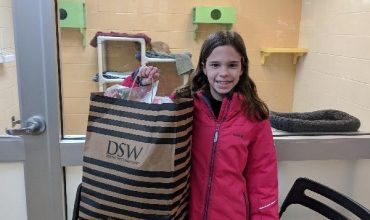
Daphne was given money from her church to create something that would help others. She chose to take that money and buy supplies to make cat beds and toys. Thank you Daphne for thinking of the kitties of HSHV for your project! We know they’ll love to snuggle in their new beds and play with all their new toys.
Read More

Dracula was found out a tree on October 30th 2013. Farley was 1 of 88 cats rescued from a hoarding situation in the early fall of 2013

When I first brought Farley home, he was very timid and afraid. He hid for about 2 weeks. So, I decided to adopt another cat to help him get over his fear. We adopted Dracula on Halloween night. He was so fun-loving and outgoing I thought he would be the perfect cat to help bring Farley out of his shell and learn to trust those around him, and Dracula has done just that.   Dracula and Farley
Read More

Unusual eating habits in dogs and cats

[print-me] Dogs and cats will sometimes eat socks, rocks or other objects, which may result in a variety of problems for both you and your pet. Not only can your possessions be destroyed or damaged, but objects such as clothing and rocks can produce life-threatening blockages in your pet’s intestines. Eating non food items is called pica. A specific type of pic is stool eating (either their own or that of another animal) and, while not necessarily dangerous to the animal, is probably unacceptable to you.  Stool eating is called coprophagy. The causes of pica and coprophagy are not known.  Many ideas have been proposed by various  experts, but none have been proven or disproven. Such behaviors may sometimes be attention-getting behaviors.  If engaging in one of these  behaviors results in some type of social interaction between the animal and his owner (even a verbal scolding) then the behavior may be reinforced and occur more frequently. These behaviors may be attempts to obtain a necessary nutrient lacking in  the diet, although no nutritional studies have ever substantiated this idea.  They may also stem from  frustration or anxiety. It’s possible behaviors begin as play, as the animal investigates and chews on the objects, then subsequently begins to eat or ingest them. It has been suggested that coprophagy is carried over from the normal parental behavior of ingesting  the waste of young offspring.  Some experts believe coprophagy occurs more often in animals who live in relatively barren environments, are frequently confined to
Read More

House Soiling Or Urine­-Marking? How To Tell The Difference!

[print-me] House Soiling Or Urine­-Marking? How To Tell The Difference! Your pet may be urine-­marking if: The problem is primarily urination. Dogs and cats rarely mark with feces. The amount of urine is small and is found primarily on vertical surfaces. Dogs and cats do sometimes mark on horizontal surfaces. Leg-­lifting and spraying are common versions of urine­-marking, but even if your pet doesn’t assume these postures, he may still be urine­-marking. Any pet in your home is not spayed or neutered. Both intact males and females are more likely to urine­-mark than are spayed or neutered animals. However, even spayed or neutered animals may mark in response to other intact animals in the
Read More