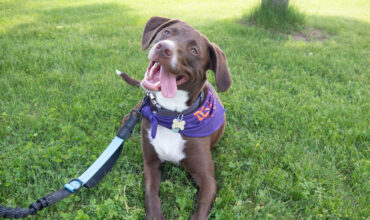
Appeasement behaviors in dogs are easy to miss and often misinterpreted. Humans often perceive these conflict-reducing behaviors as cute or affectionate, when they are often an indication of conflicted or anxious feelings. These behaviors are common during greetings with new people, when the dog feels the other dog or person they are interacting with is distressed, or if the dog themself is worried about something. Dogs express their discomfort with a variety of behaviors. Many of the behaviors that fall under the “appeasement behavior” label also fall on the lowest rungs of the “ladder of aggression.” These behaviors are often
Read More
Archives for Behavior tips
Our aging cats: What to know meow
If we’re lucky, our cats will live with us for a long time, sometimes into their 20’s. There are things we need to be prepared for as our cats age, though, or we may become discouraged with our older cat’s behavior. Litterbox care Older cat’s litterbox routines can change dramatically as their eyesight, mobility and general health change We need to change with them… they don’t mean to have accidents and they’re easily avoidable if we offer appropriate resources Elderly cats need multiple litterboxes available to them, on every level of their home Litterboxes need to have a low entry
Read More
Treat Tosses, Sniff Hunts, Hand Delivers: Speaking Your Dog’s Reward Language
Many people are familiar with the basics of marker training, where we teach the dog that a marker (often a click from a clicker, or a word like “yes”) predicts that a treat is coming. We can add even more clarity and predictability to our training by teaching our dogs specific cues for different treat delivery methods, like tossing them a treat for them to catch, taking food from our hand, or a tossed treat to sniff out in the grass. This is typically referred to as a “multiple marker system.” Using a multiple marker system can be especially helpful
Read More
The Secret Life of Cats: Why They Guard Their Favorite Things
We talk a lot about resource guarding in dogs, but not as much time is spent talking about this issue in cats. Why is that? It may be that this issue isn’t identified in cats nearly as often as dogs, though the causes and treatment are very similar. It’s much more common in kittens than in adult cats, as many, many cats grow out of this behavior, if they’re give proper resources and care. Resource guarding occurs when a cat becomes possessive or protective over a resource that they find highly valuable. That resource could be food, treats, toys, a
Read More
Looking for the ultimate reward?
Performing preference tests with your dog can help you learn a little more about what sorts of treats are highest value to them. Knowing the value of treats can help you when creating training plans and managing arousal and excitability. Being thoughtful with our treats can lead to increased clarity for our dogs and better training outcomes. How to conduct a taste test with your dog You’ll want several small dishes and a variety of treats (use small portions to prevent an upset stomach). Place a small number of treats in each bowl and place the bowls close to each
Read More
Your dog, Treat Expert
Treats are an important part of teaching your dog new skills, but it can be hard to know what treats to use for your dog. When training, it is important to choose appropriate reinforcement for the learner so that they are motivated to keep learning but still able to think clearly while we are attempting to teach. There are many variables that go into choosing treats, here are a few tips that can get you started on the road to training success. No two dogs will have all of the same preferences. Pay attention to what your dog seems to
Read More
Did I adopt a kitten… or a T-Rex?
Have you heard of the “T-Rex phase” of kitten-hood? It’s called this because kittens will sometimes stand up on their back legs, batting at things with their tiny front legs, running like crazy, much like a stampeding T-Rex. We use this phrase to describe the “terrible two’s” period of a kitten’s life, usually between eight weeks/three months to two years old, typically peaking at ten months. The age at which this phase happens and how long it lasts strongly depends on previous socialization and what they learned from mama, littermates and the humans they’ve interacted with. How did people play
Read More
Ask me first, please! – Your dog
Have you ever reached towards the head of a dog to offer some petting, only for the dog to respond by lowering their head and ears and looking up with concerned eyes? Reaching suddenly towards a dog’s head or sticking out your hand above their head for them to sniff can be intimidating and cause a stressful start to your interaction. When interacting with a dog that is ready for petting, it’s important to offer consent checks! Dogs communicate through subtle body language and consent checks allow them to communicate whether they want to continue to engage with us, or
Read More
Bringing a new cat home?
When we’re speaking to adopters or planning for bringing a new cat home, what are some of the most important things that we need to keep in mind? Patience Cats thrive on routine and control. A cat moving from one home, or coming from the streets as a stray, to the shelter, to a new home is a lot for even the most easy going cat to handle. We have to give them time to decompress, discover the routine and understand their new environment and the people in it. Patience is key during this time, each cat has to do
Read More
Step by Step… Staying Together on Walks
Taking our dogs for walks is beneficial for many reasons. It allows them to burn energy and engage with mental enrichment through sniffing the environment. It’s a bonding experience that provides the chance to explore the world around us, with their favorite person at their side. During walks, it’s always important to ensure safety and proper use of equipment. Using a properly fitted martingale collar (Picture A) will prevent your dog from slipping out of their collar. For dogs who use a harness, it is recommended to clip a carabiner from the harness onto the martingale collar (Pictures B and
Read More