


Please remember: your new kitten could be frightened and confused, even if they were happy and outgoing when you met them at the shelter.
Read More
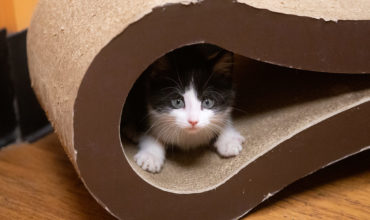
Please remember: your new kitten could be frightened and confused, even if they were happy and outgoing when you met them at the shelter.
Read More

Most dogs enjoy petting, but even the cuddliest dog has times when simply not in the mood! Prolonged touching can be overstimulating to some dogs, and can make others uncomfortable or stressed. When dogs don’t feel able to move away – which they may not when in physical contact with us – they may resort to telling us to back off in less desirable ways. Give dogs a way of “opting in” to social contact by using the “3-second rule” of petting. Pet for no more than three seconds, then stop. Does the dog nudge you or move into
Read More

Lots of people know or love what could be called a “sassy” cat. Often, when we say “sassy,” we mean a cat who just doesn’t like to be petted for too long, or has certain parts of their bodies that they object to being handled. These guys are usually cats who also feel pretty uncomfortable when we try to pick them up. Commonly, any of these actions performed by a human will result in a nip or bite. Before that bite, though, we’ve probably missed a whole series of behaviors and body language cues that were telling us to stop
Read More

Do you and your dog both dread toe-nail trims? Then why not give your dog the opportunity to give themselves a pedicure on their own by making it into a simple trick? By taping some sandpaper to a plywood board or something similar, you can create a canine nail file! It is easy to train a dog to swipe their paw on the sandpaper, and as they do so, they will end up filing their own nails. Doing a few swipes a day a couple times a week can keep nails from getting unmanageable, and reduce how frequently you need
Read More
(Did you miss Part 1?) We show you how to train your dog to file their own nails by swiping at a sandpaper board… and while it is often relatively easy to teach the dog to file their front paws, teaching them to swipe with their rear feet can be a little more challenging. So we like to introduce a little environmental help! Sit on a chair, couch, footstool, etc. and prop your nail file board up at an angle in front of you. Have your dog in front of you and the board. Use a food lure to have
Read More

To help a fearful kitty, the best thing you can do is to give that cat a safe room to call home, go slowly and be prepared with a lot of great food motivators.
Read More

It’s not uncommon to see some quirky or concerning behavior not long after bringing your newly adopted cat or kitten home.
Read More

The decision to adopt a new cat or kitten is a big one, especially when you’ve already got an adult cat or two in the home. Folks often say that adopting a young cat or kitten can help an adult cat who’s lost a feline companion or can invigorate an adult or even elderly cat but, often, this can lead to a strong stress response in the adult, resident cat. An adult cat with an unknown history with other cats, an elderly cat who’s been the only cat for a long time, or even a cat who’s lived with other
Read More

How to Introduce Your Cat to Clicker Training (Beginner Guide) What do you need? A clicker A cat A relatively quiet space Some very exciting treats or wet food. The treats should be broken up into small, pea sized pieces. It’s important that you use food or treats that your cat truly loves, and, if possible, save that food motivator for the times that you’re training with your cat. Cats can be picky, your cat may change his mind about what he loves most, so you may need to swap treats or wet food out often to keep him interested. You can use a spoon to offer wet food, if your cat is
Read More

[print-me] It’s been an uncertain time for all of us – including the kitties in our lives. We’re home more and our cats are likely wondering why their nap schedule has been suddenly thrown off by human intervention. Cats thrive on schedule/routine, and even if they’re used to you being home, they’re likely not used to you being home ALL of the time, and their normalcy can be easily disrupted. Cats may respond to this change in many ways, like being active at times they’re usually not (cat suddenly waking you up at night?), vocalizing more than normal, seeking
Read More