Archives for Behavior tips

Returning to work? How to prepare your dog

[print-me]   Is your dog actually loving the current stay-at-home order?  Pets may be the one part of the population who are not minding this new routine, as now they have you all to themselves all day long!  While you are hopefully enjoying all this extra time with your pets, you may have concerns about how your puppy or dog is going to adjust when things start to return to normal and we are leaving during the day again.  Now is the time to start working on preparing your dog for this eventual change.   First, set up a special
Read More

Tips for Resolving Litterbox Problems

Why Do Some Cats Eliminate Outside the Litter Box? Litter box use problems in cats can be diverse and complex. Behavioral treatments are often effective, but the treatments must be tailored to the cat’s specific problem. Be certain to read the entire article to help you identify your particular cat’s problem and to familiarize yourself with the different resolution approaches to ensure success with your cat.   Litter box Management Problems If your cat isn’t comfortable with her litter box or can’t easily access it, she probably won’t use it. The following common litter-box problems might cause her to eliminate
Read More

Food bowl bonuses (a.k.a., Teaching puppy to share)

Background Info Resource guarding is a term used to describe situations in which dogs are in possession of an item and want to retain possession of it. In the wild, this tends to be a life or death situation in that if the dog let another animal take possession of his/her food s/he would ultimately die of starvation. Dogs are naturally highly motivated to retain possession of the resource so that they survive. While this survival instinct served dogs well in the wild, it’s not one we appreciate in our pet dogs, so we need to teach our puppies to
Read More

Dog Meets Young Child

[print-me] This is intended as a broad overview of things to consider with Dog and Toddler and Dog and Preschooler dynamics. These are constantly evolving as a child grows and develops. The challenge here is that dogs rely on predictability and consistent body language in interacting with us and with children change and development happen quickly, particularly in the first 2 years of a child’s life. From a dog’s perspective, babies are confusing and a newly mobile baby or racing toddler is an unpredictable, erratic, worrisome creature. Please note that because a dog has been “around kids” does not mean
Read More

Dog Meets Baby

[print-me] Having a baby changes everything, for everyone – including the family dog. As children come into our lives there are myriad changes in how we spend our time, how much time we have, how our homes are organized – just for starters! This piece is intended as a broad overview of things to consider before your baby is due and right after your baby arrives. While your dog may have spent time with babies, there are big differences in bringing a newborn home and then having a child in your home 24/7 – for all of you. Preparing the
Read More

Teaching “Watch”

[print-me] Why teach “Watch”? Because getting your dog’s focus with a single word is very useful. You can distract him from enticing trash in the street, for example, or keep his eyes on you when walking past another dog. Plus, dogs that are rewarded for paying attention do it more. And attentive dogs are easier to train. How to teach “Watch” Step 1. Grab a bunch of small, delicious treats. Face your dog—he can be sitting, lying down, or standing. Step 2. At first, praise and treat your dog for looking at your feet or for turning in your direction.
Read More

Teaching “Sit-Stay”

[print-me] Getting dogs to hold still can be a real challenge. Their energy seems to have no boundaries. Still we need them to greet nicely, wait at the door – to just hold still, but sitting still takes practice for a dog. The key to building a rock-solid stay is to practice small, incremental steps. Here we will focus on duration, teaching our dog to hold a sit for longer periods of time. Going too fast causes your dog to fail and is the best way to build a spotty command. Instead, we always want to work at our dog’s
Read More

Teaching “Sit”

[print-me] Step One: Lure In this step you are literally persuading the dog to sit by slowly raising the treat above his head just between his ears while he follows the food. Start by getting the dog interested in the food by putting it right in front of his nose. Once he’s interested in the food, you’ll slowly raise it up above his head in a half circle motion. Keep the treat close to your dog’s nose—if you move your hand down too quickly or too far away from his mouth, he may not understand what you’re asking. Step Two:
Read More

Teaching “Side”

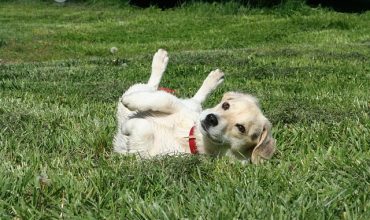
[print-me] The command “side” is used for a dog to roll over onto his side. To teach the dog to lie on his side: Step One: Lure With the dog in a “Sit,” hold a treat in front of his/her nose, then lure SLOWLY straight to the floor at the dog’s toes (dog moves into a “Down”). Step Two: Mark & Reward Continue luring the dog over onto his side by moving the treat over the dog’s shoulder. Mark (click) and reward when he shifts his body even slightly. If possible, lure until the dog lies his/her head to the
Read More

Teaching “Shake”

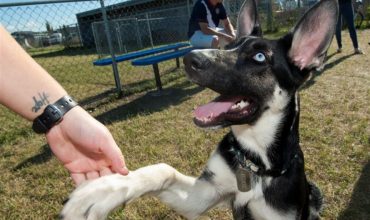
[print-me] Step One: Lure. Mark & Reward Start with your dog in a sit. Get a treat, show it to the dog and then make fist, closing the treat in your hand. Hold your fist out in front of the dog. The dog will begin to experiment to see what works to get the treat out of your hand (usually sniffing, licking, etc.). The second the dog goes to paw at your hand, click and open your fist to release the treat. Step Two: Repeat it Repeat until your dog immediately goes to paw at your hand when you close
Read More